


We've designed this 2026 buying guide to provide the clarity you need to move forward with confidence. By the end of this article, you'll have a transparent roadmap for budgeting that accounts for everything from senior engineering talent to essential compliance protocols. We'll preview the current market landscape for enterprise platforms and mid-level applications, while showing you how to optimize your investment without sacrificing the quality or scalability your business demands. This is your blueprint for aligning technical execution with commercial success in the Emirates' evolving digital landscape.
Key Takeaways
- Understand how the UAE's national digital transformation agenda is elevating quality standards and resilience requirements for all new software investments.
- Learn to identify the primary drivers of software development cost UAE, from functional complexity to the long-term impact of your chosen technical stack.
- Establish realistic 2026 budgetary benchmarks for projects ranging from high-potential MVPs to complex, integrated enterprise ecosystems.
- Discover how integrating cybersecurity and PDPL compliance from the outset prevents expensive redesigns and ensures long-term regulatory stability.
- Explore strategic scaling methods like staff augmentation to access elite technical talent without the burden of permanent fixed overheads.
Evaluating the Software Development Landscape in the UAE for 2026
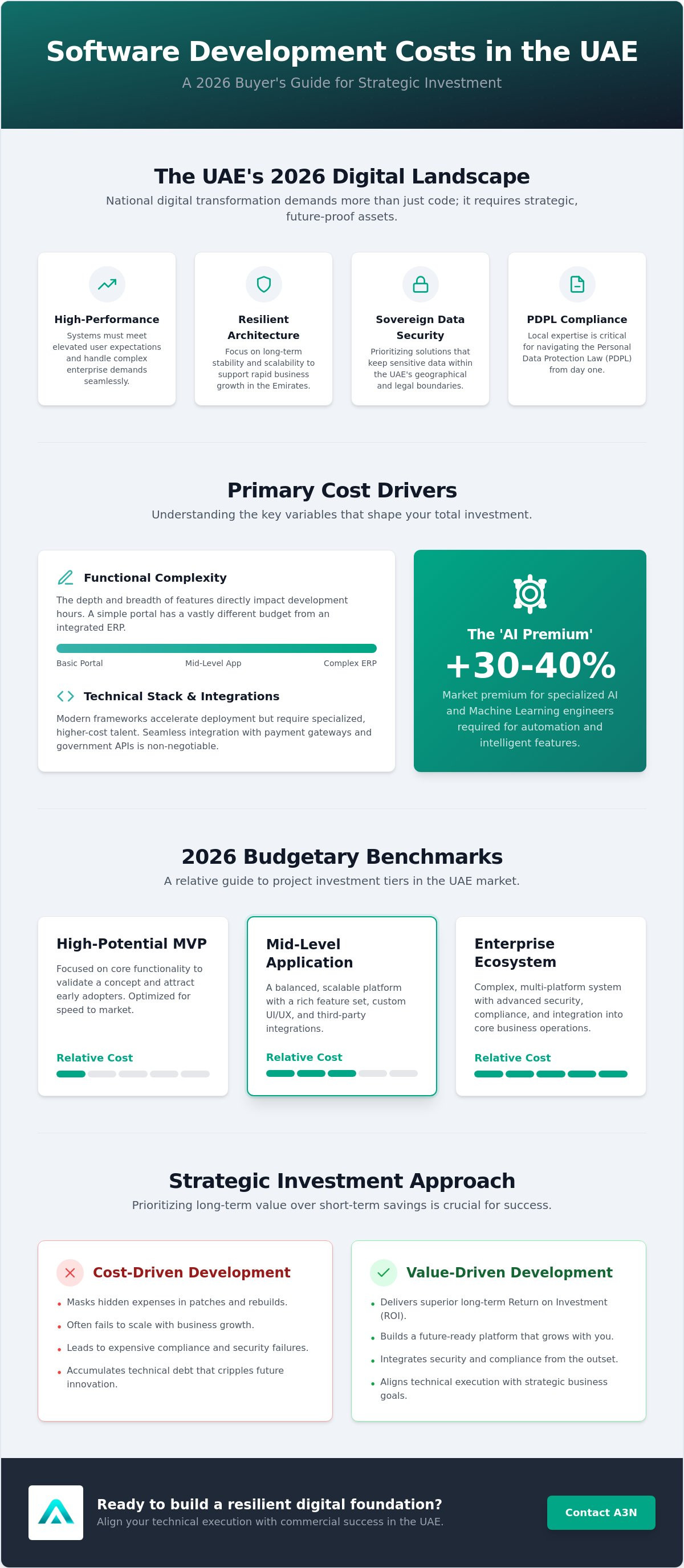
The digital landscape in the Emirates has evolved far beyond basic web presence. By 2026, the focus has shifted toward high-performance, resilient digital ecosystems that can handle complex enterprise demands. This transition directly impacts the software development cost UAE, as businesses are no longer just purchasing code; they're acquiring strategic assets designed for long-term stability. It's a sophisticated market. Organizations now demand systems that integrate seamlessly with national infrastructure while maintaining the highest standards of data security.
National goals, such as the UAE's E-Government initiatives, have set a high benchmark for technical excellence. When the public sector leads with seamless digital services, private enterprises must follow suit to remain competitive. This environment creates a demand for sophisticated architectures that prioritize security and local regulatory compliance. Choosing local expertise over generic offshore models is no longer just a preference. It's a risk mitigation strategy. Local teams understand the nuances of the UAE Personal Data Protection Law (PDPL) and the technical requirements of the nation's high-tier infrastructure. While offshore rates might seem attractive, they often lack the contextual knowledge required to navigate the Emirates' specific digital regulations.
The Maturation of the UAE Tech Market
User expectations for UI/UX in 2026 are at an all-time high. Performance isn't optional; it's the baseline for any serious commercial venture. We're seeing a significant move toward sovereign software solutions that keep data integrity at the forefront. This shift ensures that sensitive information remains within the geographical and legal boundaries of the UAE. The UAE maintains a globally competitive tech posture that attracts world-class talent and fosters massive innovation. This maturity means that initial project estimates must account for advanced testing, localized user journey mapping, and robust cybersecurity frameworks from day one.
Value-Driven vs. Cost-Driven Development
A low initial price tag often masks hidden expenses. Cheaply built systems frequently require expensive patches or complete rebuilds when they fail to scale or meet compliance audits. In a rapidly growing economy, your software must be ready for sudden expansion. Custom development offers a superior ROI because it aligns with your specific operational goals and the country's fast-paced business environment. It's about building a system that grows with you. By prioritizing value over the lowest quote, you're protecting your business from the technical debt that often cripples less prepared competitors. Strategic alignment ensures that every dirham spent contributes to a scalable, future-ready platform.
Primary Determinants of Custom Software Development Investment
Calculating your investment requires a move beyond surface-level feature lists. In the current market, the software development cost UAE businesses encounter is primarily driven by the depth of functional complexity and the sophistication of the underlying architecture. A basic customer-facing portal serves a vital purpose, yet its budgetary requirements differ vastly from a fully integrated Enterprise Resource Planning (ERP) system. As the UAE's Digital Economy Strategy continues to accelerate the nation's non-oil GDP growth, the demand for these high-performance, resilient systems has become the standard for any organization aiming for market leadership.
Technical stack choices also play a pivotal role in shaping your budget. Modern frameworks can accelerate deployment speeds, but they often require specialized talent that commands a higher market rate. We're seeing a distinct 'AI Premium' in 2026. Integrating automation and machine learning isn't just a trend; it's a competitive necessity that requires AI engineers who typically earn a 30% to 40% premium over standard developers. Beyond intelligence, your software must integrate seamlessly with national payment gateways and government APIs. These integrations ensure your platform operates within the local ecosystem's legal and functional frameworks, providing a frictionless experience for your end-users.
Architecture and Scalability Requirements
Building for a thousand users is a different engineering challenge than building for a million. Scalability dictates your choice of database, server structure, and load-balancing protocols. Cloud-native development offers incredible flexibility, but it shifts some costs from upfront capital expenditure to ongoing operational investment. It's a strategic trade-off. By investing in a future-proof architecture now, you avoid the devastating expense of a mid-cycle re-write when your user base grows. If you're looking for a partner to build this foundation, exploring comprehensive software development services can help clarify these architectural priorities.
Personnel and Team Composition
The success of your project rests on the hands that build it. You must decide between maintaining an internal team, hiring a project-based agency, or utilizing staff augmentation. Each model has its own financial profile. In the UAE, specialized roles like blockchain developers and cybersecurity experts are in high demand due to strict PDPL enforcement. Seniority levels also correlate directly with project success rates. While junior developers offer lower hourly rates, senior engineers provide the stability and foresight needed to navigate complex technical landscapes without costly errors. Choosing the right mix of talent is essential for maintaining both quality and budgetary control.
2026 Budgetary Benchmarks for UAE Software Projects
The 2026 economic environment in the Emirates demands a shift from speculative budgeting to data-driven financial planning. Understanding the software development cost UAE requires a clear-eyed look at the current market benchmarks. These figures aren't just numbers on a spreadsheet. They represent the investment required to compete within the framework of the UAE Digital Economy Strategy, which continues to prioritize high-value ICT growth. For many organizations, the journey begins with a Minimum Viable Product (MVP). This strategic entry point allows startups and established firms alike to validate core concepts with a leaner initial investment, typically starting around AED 80,000 for a functional, high-quality prototype.
As projects move toward enterprise-grade complexity, the financial commitment scales to match the increased demands for security, scalability, and deep system integration. High-scale platforms that handle massive data processing or utilize advanced AI often exceed AED 1,800,000. It's also vital to account for the total cost of ownership. Maintenance and cloud hosting aren't afterthoughts; they're essential for system health. You should plan to allocate between 15% and 25% of your initial development spend annually. This recurring investment covers critical security patches, server optimizations, and the ongoing compliance audits required to satisfy local data residency laws.
Project Tiers and Estimated Ranges
- Tier 1: Bespoke Web Applications. These advanced portals focus on high-conversion UI/UX and seamless user journeys. Mid-level business applications in this category typically range from AED 250,000 to AED 600,000.
- Tier 2: Comprehensive Mobile Apps. Projects involving complex backend integrations and cross-platform functionality usually sit in the upper mid-range. The final price depends heavily on the number of third-party APIs and the complexity of real-time data synchronization.
- Tier 3: Enterprise Systems. These are the heavy hitters of the digital world. Platforms involving blockchain, machine learning, or massive concurrent user loads represent the peak of the market. They often require budgets above AED 1,800,000 to meet the stringent national security and performance standards expected in 2026.
Engagement Models and Their Financial Impact
Choosing the right partnership model is as critical as the code itself. Fixed-price contracts provide a sense of security for well-defined scopes. They're ideal for risk mitigation in straightforward projects where the roadmap is clear. However, for dynamic industries where requirements evolve rapidly, the Time and Materials model offers the flexibility needed to pivot without constant contract renegotiations. Many forward-thinking UAE firms are now leaning toward Dedicated Development Teams. This model, often supported by staff augmentation, provides long-term cost efficiency. It allows you to maintain momentum and ensure continuous product evolution while keeping full control over the technical roadmap and team seniority.
Strategic Optimization: Balancing Cost with Security and Compliance
Optimization isn't about cutting corners. It's about precision. In the Emirates, failing to account for the Personal Data Protection Law (PDPL) from the start is the most expensive mistake a leader can make. Non-compliance can lead to fines reaching up to AED 5 million, turning a perceived saving into a massive liability. This risk makes the software development cost UAE businesses encounter a matter of strategic resilience. Integrating proactive cybersecurity solutions into your initial build isn't an extra expense; it's a shield against catastrophic financial loss and brand erosion.
You can scale your team's capabilities without the weight of permanent fixed overheads. Staff augmentation allows you to inject specialized talent, such as senior AI engineers or blockchain experts, exactly when the project demands it. This model provides the agility to move fast while keeping your core budget lean. Leveraging AI-driven development tools also accelerates timelines significantly. These tools don't replace human expertise, but they do streamline repetitive coding tasks. This reduction in man-hours directly lowers your total investment while maintaining a high standard of code quality.
Compliance as a Cost-Saving Strategy
Adhering to national data protection laws is a financial imperative. By embedding secure web application development practices into your core architecture, you eliminate the need for expensive post-launch patches. It's a proactive stance. Conducting comprehensive security audits during the development phase typically saves 30% in post-launch remediation costs. This methodical approach ensures your platform is ready for the scrutiny of both regulators and users from day one. It builds the long-term trust necessary for sustainable growth in a competitive digital economy.
The MVP Approach to Capital Management
A phased roadmap is your best defense against feature creep. By prioritizing high-ROI features for your Minimum Viable Product (MVP), you accelerate your time-to-market and begin gathering real-world user data immediately. This data informs your phase 2 budget. It ensures every subsequent dirham is spent on features your customers actually value. It's a disciplined way to manage capital. You avoid the trap of building complex systems that remain underutilized, keeping your development spending focused on actual market demand and operational efficiency.
Selecting Your Strategic Technology Partner in the UAE
Choosing a technology partner in the Emirates is a decision that defines your organization's trajectory for years to come. It's about more than just finding the lowest software development cost UAE can offer. It's about securing a strategic ally that provides stability in a rapidly changing environment. A3N represents the pinnacle of professional authority in the region. We don't just write code; we build resilient digital ecosystems. Navigating the complexities of software development cost UAE requires a partner who understands the broader journey of a business and remains grounded in practical, result-driven execution.
Our holistic value proposition stems from an integrated suite of services. We combine Website & Software Development with high-tier AI & Automation Solutions and robust Cybersecurity Solutions. This unified approach eliminates the friction often found when managing multiple vendors. It streamlines complex processes and accelerates your transformation. By taking full ownership of the technical landscape, we allow you to focus entirely on your own growth. Our commitment to national standards ensures that your digital assets align perfectly with the UAE's ambitious digital transformation goals, providing a secure and stable force for your operations.
Beyond Coding: The A3N Strategic Advantage
Digital success requires a blend of technical prowess and market appeal. Our expertise in UI/UX Design and Branding & Corporate Identity ensures that your software isn't just powerful; it's marketable and user-centric. We've seen how UAE-based organizations transform when they move from fragmented tools to cohesive, resilient platforms. Our history is built on successful digital transformation projects for local entities, where we've streamlined operations and enhanced user engagement through scalable architecture. This grounded execution is the hallmark of the A3N methodology. We translate visionary concepts into practical systems that scale effortlessly as your business expands within the region's dynamic economy.
Next Steps for Your Digital Roadmap
Accurate budgeting begins with a comprehensive discovery phase. This initial step allows us to align technical requirements with your specific business objectives, ensuring the final roadmap is both realistic and transparent. It prevents the unpredictable cost overruns that often plague less structured projects. We invite you to initiate a consultation that goes beyond technical specifications to explore your broader commercial journey. It's time to build a partnership based on dedicated support and long-term trust. Partner with A3N for your 2026 digital transformation and take the first step toward a more resilient and ambitious digital future.
Building for Resilience in the UAE’s Digital Economy
Success in 2026 requires a shift from viewing technology as a commodity to seeing it as a strategic asset. We've explored how functional complexity, architectural scalability, and strict PDPL compliance define the modern software development cost UAE landscape. It's no longer enough to simply launch an application. You must build a system that is future-ready and inherently secure. By prioritizing value-driven development and strategic talent allocation, you protect your investment from technical debt and regulatory risk. This proactive approach ensures your organization remains competitive within the Emirates' rapidly evolving digital framework.
A3N serves as your visionary guide through this transformation. We combine specialized technical expertise in AI and Cloud with comprehensive cybersecurity integration to ensure your systems are both innovative and stable. Our methodology moves your visionary concepts toward grounded, result-driven execution that aligns with national standards. It's time to take full ownership of your technical roadmap. Request a Strategic Consultation and Custom Quote from A3N to begin your journey with a partner committed to your long-term growth. Your digital evolution starts with a single, strategic decision.
Frequently Asked Questions
How much does a typical software project cost in the UAE in 2026?
Project investments typically range from AED 80,000 for a high-quality Minimum Viable Product (MVP) to over AED 1,800,000 for complex enterprise platforms. Mid-level business applications generally fall between AED 250,000 and AED 600,000. These figures reflect the 2026 market demand for high-performance systems that meet strict national security and performance standards.
Why is custom software development more expensive than using a SaaS platform?
Custom development is a strategic investment in full ownership and unique competitive advantage. While SaaS platforms offer lower entry costs, they involve recurring per-user licensing fees and lack the ability to scale exactly to your specific operational needs. A custom solution eliminates these long-term overheads and ensures your architecture is perfectly aligned with your business roadmap.
What are the hidden costs of software development I should budget for?
Ongoing maintenance typically requires 15% to 25% of the initial development cost annually to cover security patches and server optimizations. You should also account for payment gateway integrations, which can add between AED 11,000 and AED 29,000 to your budget. Cloud hosting and localized compliance audits are additional essential factors for maintaining system health and legal standing.
How does the complexity of UI/UX design affect the final project price?
Sophisticated UI/UX design increases the software development cost UAE by requiring localized user journey mapping and high-fidelity prototyping. Investing in a brand-aligned, high-conversion interface is vital for marketability in the Emirates' competitive digital landscape. This precision ensures that your platform isn't just functional, but also resonates deeply with your target audience to drive growth.
Can I reduce costs by using offshore developers for a UAE-based project?
Offshoring can manage hourly rates, but it often introduces significant risks regarding PDPL compliance and data residency requirements. Many organizations find that staff augmentation or nearshoring provides a more stable balance of cost and quality. This approach ensures that your technical team understands the local regulatory environment while maintaining the agility needed for rapid deployment.
What is the average timeline for developing a custom enterprise solution?
Enterprise platforms typically require a development timeline of 9 to 18 months depending on the depth of integration and functional complexity. A strategic MVP can often be launched within 3 to 4 months to begin gathering real-world user data. This phased approach allows you to manage capital efficiently while maintaining momentum toward your long-term digital transformation goals.
How do UAE cybersecurity regulations impact the development budget?
Strict enforcement of the Personal Data Protection Law (PDPL) necessitates a 'security by design' approach that adds upfront costs for encryption and audits. While this increases the initial software development cost UAE, it serves as a critical shield against non-compliance fines that can reach AED 5 million. Proactive security integration is a fundamental cost-saving strategy that prevents expensive post-launch remediation.
What is the difference between a fixed-price and a time-and-materials quote?
Fixed-price contracts provide absolute budget certainty for projects with a clearly defined and stable scope. They're ideal for risk mitigation in straightforward builds where the roadmap is established from day one. In contrast, time-and-materials quotes offer the flexibility needed for evolving projects in dynamic industries, allowing you to pivot features based on real-time market feedback.